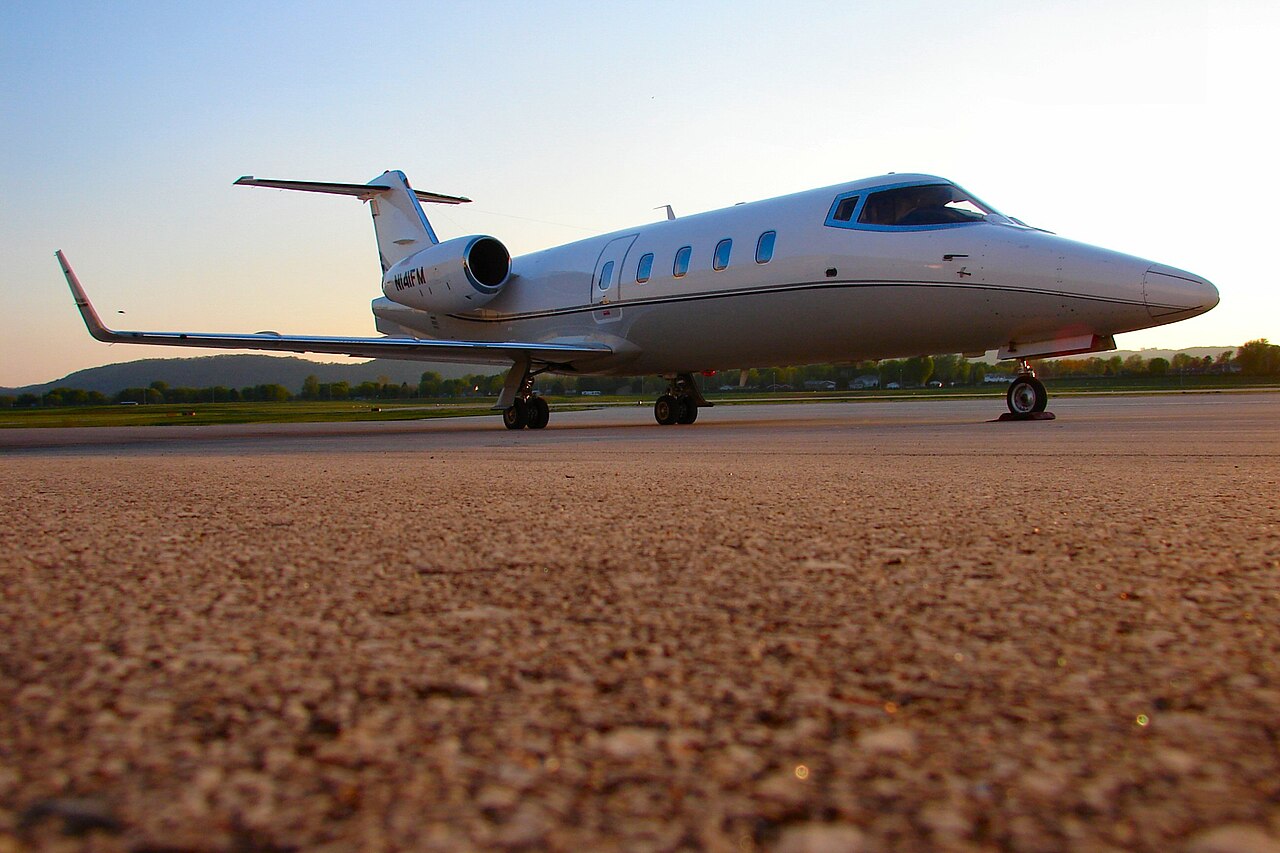
The Learjet 55 is a midsize jet produced between 1981 and 1987. It has a range of 2165 nm, a cruise speed of 442 kt (819 km/h), Mach 0.77, up to 10 passengers. Out of production; on the used market the median is around US$ 625.000. In Brazil there are 23 units registered in the RAB-ANAC. There are 6 aircraft from this family for sale today, across 6 listings on the portals Jet Tracker tracks (global market, not Brazil only).
Source: RAB-ANAC (data as of 9/22/2026) and Jet Tracker catalog (spec sheet reviewed on 9/6/2026).
market medianaging ≈ −4.8%/yr−81% vs Midsize median
Entry
US$ 595.0 mil
model year 1981
Best value
US$ 610.0 mil
model year 1983
Top of range
US$ 800.0 mil
model year 1987
Basis
Valuation
Bluebook + market
Minimum
US$ 465.0 mil
R$ 2.4 mi
Median
US$ 625.0 mil
R$ 3.2 mi
Maximum
US$ 965.0 mil
R$ 4.9 mi
Depreciation curve by year of manufacture
CAGR +5.1%/yr·1981→1987
Market median by vintage (USD). Light-blue band = min/max range observed across real listings. Points without reliable public listings (n ≤ 1) use Bluebook/curve interpolation and are flagged as lower confidence.
7 of 7 points with reduced confidence (n ≤ 1 listing observed). The estimate for these years comes from Aircraft Bluebook / market-curve interpolation, not from direct listings.
Landed in Brazil
Index ≈ ×1.26 to ×1.59 on the aircraft value, already with ferry, ANAC nationalization and ICMS.
Air taxi
US$ 583.6 mil – 1.3 mi
R$ 3.0 mi – 6.9 mi · ICMS Agreement 75/91 · ~4 to 5%
Private use
US$ 648.7 mil – 1.5 mi
R$ 3.3 mi – 7.9 mi · ICMS ~18 to 25%
Market estimate: value + ferry + ANAC nationalization + ICMS, no legal review. Federal taxes (II/IPI/PIS/COFINS) ~0% for aircraft (NCM 88.02); the weight is the state ICMS, higher for private use.
Cost per flight hour
Operate · owned
US$ 3.2 mil/h
R$ 16.4 mil/h · Variable/h
Fixed/yr
US$ 404.0 mil
Total/h @ 400 hrs/yr
US$ 4.2 mil/h
Charter · 🌎 World
US$ 2.7 mil – 3.5 mil/h
R$ 13.8 mil – 17.9 mil/h
Operate = direct cost/hour (fuel + maintenance + engine); excludes fixed costs (hangar, crew, insurance). World hourly converges across operators: Mercury Jets ~$3,400, Monarch ~$3,300, flycraft $3,050, evoJets quoted $2,700-$3,200, Jettly $2,800-$3,500. No Brazil-specific Learjet 55 charter hourly rate found published (Flapper/operadores).
How we read this price · 7 sources · researched 04/06/2026
Discontinued midsize (1981-1987, ~147 built). Pre-owned asking converges low: GlobalAir 2 active listings both $595k (1981 SN006, 1982 SN054, accessed Jun-2026); Controller range $465k-$965k; planephd PAPI estimate $582,578 for MY1982-1986 (as of Mar-2026); aviacost avg $717,879; evoJets range $787.5k-$962.5k; flycraft avg $901,500 / range $500k-$1M. Median set at $625k between live asking pair and PAPI/aviacost estimates. DOC (variable/hr): aviacost $4,016, flycraft ~$4,245 (fuel $2,136+maint $1,752+overhaul $357), evoJets $2,602-$3,180; central ~$3,500/hr. Fuel burn ~204-244 GPH.
Dispatches under charter rules at 145 of 465 Brazilian public runways when dry, and at 82 when wet.
Where it fits under charter rules, calm air
Click the runway figure to open the official aerodrome chart and check it. Declared distance from AISWEB (2026-09-05); where none exists, physical length is used.
Pro feature. Available on your Jet Tracker account.
Manufacturer-published distances at sea level, ISA and reference weight. Not corrected for altitude, temperature, wind or runway condition, takeoff included. Uses the declared LDA as a proxy for effective runway length (RBAC 135.361) and the most favourable threshold in calm air (135.385(b)(1)): on the day, wind may force the shorter threshold. Destination only: does not assess the alternate aerodrome (135.387). Not a substitute for the AFM or the operator's performance analysis. Rule: RBAC 135.385 and 135.398; private flying (RBAC 91) is not factored. Runways: declared distance (LDA) from AISWEB/DECEA (2026-09-05), checkable on each aerodrome chart; where DECEA publishes no declared distance, physical length from OurAirports is used.
Typical factory configuration (curated data). The drawing below is schematic and at approximate scale; the actual layout varies by interior and year.
Cabin to scale: cross-section and profile
✗ no stand-up height
front cross-section · person = 1.75 m
Length
4,18 m
Width
1,8 m
Height
1,74 m
Volume
—
Baggage
—
History
1979First flight
1981FAA certification
1981 - Primeiro midsize Lear da história
Lançado em 1981 (primeira entrega março de 1981), foi o primeiro Lear a romper a tradição de cabines compactas, cabine stand-up de 1,73m permitiu pela primeira vez que passageiros andassem em pé num Learjet. Marco da transição da marca do segmento light para midsize.
Foi o primeiro avião civil de produção a incorporar winglets, design baseado diretamente nas pesquisas da NASA do engenheiro Richard Whitcomb. As winglets reduzem arrasto induzido em 4-6% e foram o motivo do apelido 'Longhorn' (chifres longos, em alusão ao gado texano).
Model with no documented lineage in the manufacturer's line.
Curiosities and highlights
Benefits
Teto de 51.000 pés em cabine stand-up
Combinação rara: cabine de 1,73m de altura (passageiros em pé) com teto operacional de 51.000 pés, voa acima de tráfego comercial e tempestades, proporcionando viagens mais suaves. Range de 2.165nm cobre transcontinentais EUA com folga.
Apenas 147 unidades produzidas em 6 anos, vendas decepcionantes comparadas aos 738 do Lear 35A. Preço alto (US$ 4-5M na época), peso elevado e a chegada do Cessna Citation III/VI/VII no mesmo segmento limitaram o sucesso comercial. Lear 55 foi rapidamente sucedido pelo Lear 60 em 1991.
Bill Lear faleceu em 1978, três anos antes do primeiro voo do 55, mas o projeto foi conduzido por seu filho William Powell Lear Jr., piloto de testes da própria empresa. Foi a primeira aeronave Lear desenvolvida sem a presença direta do fundador, um marco simbólico da nova geração da marca.
Os modelos 55B (1986) e 55C (1987) foram pioneiros em glass cockpit no segmento midsize, Collins EFIS-86 com 4 telas substituindo instrumentos analógicos. Antecipou em 5+ anos a adoção de glass cockpit que se tornaria padrão na década de 1990.
The Learjet 55 is out of production, so there is no factory price. On the used market the median is around US$ 625.000, varying with year and flight hours; see real listings on this model's Market tab.
What is the range of the Learjet 55?+
The maximum range is 2165 nm (2.165 NM · 4.010 km).
How fast is the Learjet 55?+
Cruise speed is 442 kt, equivalent to 819 km/h, or Mach 0.77.
How many passengers does the Learjet 55 seat?+
The Learjet 55 seats up to 10 passengers, crew not included.
How many Learjet 55 are there in Brazil?+
There are 23 units registered in the RAB-ANAC (data as of 9/22/2026).
Who operates the Learjet 55 in Brazil?+
16 distinct operators operate 22 units of the Learjet 55 in the RAB-ANAC: 11 in air taxi (RBAC 135) and 11 in private operation (RBAC 91), concentrated in MG, SP and PR (data as of 9/22/2026). Another 1 unit is under registration reservation (tail number reserved, not yet operating). Name, fleet and base of each operator are on this model's Analytics tab and in the operators directory.
How much does it cost to operate a Learjet 55 per hour?+
Jet Tracker estimate: about US$ 4,207 per flight hour at 400 h/year, of which US$ 3,197 per hour is variable cost (fuel, engine program, maintenance reserves) plus US$ 404,000 per year of fixed cost (crew, hangar, insurance), under Jet Tracker's default assumptions (Southeast Brazil, in-house crew, 400 h/year). Run your own scenario on this model's Costs tab.